Finite spectral triples and Kaluza-Klein limits
The papers study whether the finite part of an almost-commutative spectral triple can be read as a low-energy window of an internal geometry. An interval supplies an exact setting in which a finite spectrum, wall data and a Kaluza-Klein tower can be compared. The seven-dimensional construction, the gauge sector and the proposed connections to string theory ask how much of that picture can extend beyond the interval.
This discussion brings the common ideas together. Each link leads to the full paper, including its hypotheses, proofs or proof sketches, citations, status and provenance. The papers are drafts with no listed authors; they have not been submitted or peer reviewed. Their independent model checks and remaining qualifications are recorded in the papers and supplements.
What the dimensions mean
The finite Standard Model triple has metric dimension zero and KO-dimension six. The labels 9 and 11 arise from odd factorizations of a KO-6 triple after including four-dimensional spacetime; they are KO-degrees rather than measurements of a geometric dimension. A geometric dimension is tested separately, for example by the growth of a tower or a heat trace.
In the reduced representation, charged paired sectors can admit both factorizations. A sector with one or three unpaired neutrinos admits only the KO-7 factorization under the stated criterion, while the full chiral representation admits neither. Reading the two labels as limits of an even interior is a proposal; identifying those limits with physical parameters remains open. See the real-structure analysis in the main paper and the reduced fermion action.
The two-point space and the interval
For a massless Dirac operator on an interval of length , with opposite chiral boundary conditions at its two ends, the lowest pair of modes compresses exactly to the Connes-Lott two-point operator , with . The compressed algebra of functions is ; the two states correspond to smeared measures on the interval. Higher modes form a tower, so the two-point model is a spectral window. The inherited real structure and first-order condition require separate attention.
Adding a negative bulk mass produces a light pair when . In the long-interval limit at fixed , the modes localize at opposite walls and the tower develops one-dimensional Weyl growth above the gap. A collapse with a fixed light mass instead needs a tuned bulk mass or a scaled boundary coupling; the massless interval alone leaves no light modes at a fixed cutoff. These are statements about the specified boundary families. The main paper’s interval construction, bulk-mass limits, and boundary Yukawa discussion give the formulas and scopes.
Finite data as wall data
For a finite Dirac operator with KO-6 signs, the boundary-condition paper constructs a matrix-valued interval parent with an exact lowest window whenever . Its masses are principal angles divided by , and the signed tower has levels . A pair of wall gradings determines the finite operator through when the principal logarithm is defined.
The construction also preserves the real structure and grading on the window. Wall observables are restricted by the commutant of the grading, and constant observables compress to an average under the finite Dirac evolution, approaching the finite representation at order . The finite data and the matrix-valued parent are inputs: the construction does not select the Standard Model algebra. See the exact window, algebra and compression, and the dictionary.
The interval component of a connection relates finite fluctuations to wall transport. With one interval, fixed boundary data, no bulk masses, even scalar inner fluctuations and a moving window, the singular values stay fixed. The paper describes possible directions outside those hypotheses, including varying wall data, odd terms and further internal dimensions. The odd quaternionic directions give an field space in the specified construction. See fluctuations and the Higgs entry in the dictionary.
Opening a tower
Massless weak vectors alone do not determine whether a tower opens. In the interval gauge toy, the vector masses can vanish at fixed while the tower spacing stays fixed. The opening-tower paper specifies a family with a light scale , a moving observation scale , and a first discarded scale satisfying
(1)
It also requires and proves a divergent state count at each fixed positive energy for its examples. For the interval family , with and , a choice and retains a fixed finite window while the fixed-energy count grows like .
Opening-window hierarchy
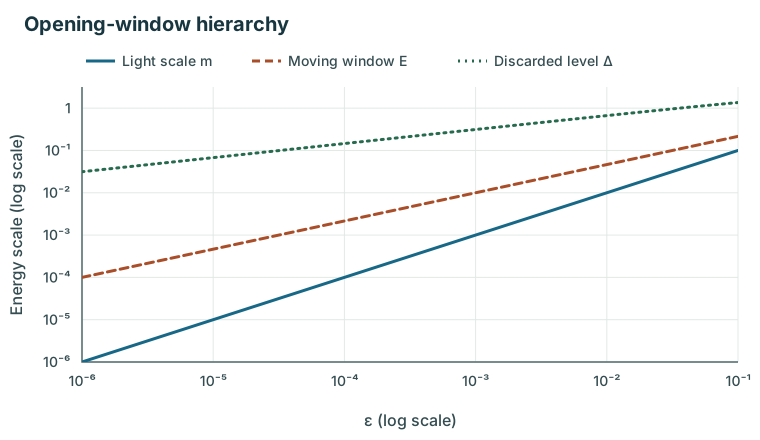
On a disc bundle over , a local Dirac operator with a Callias potential yields an eight-state fermion window for the stated metrics, and an expanding family has seven-dimensional Weyl growth. On that parent, the relation between the tunnelling scale and the and masses, the vector sector, couplings, physical chirality and dynamics selecting the family remain open. See the interval family, the local window, the joint limit and what is missing.
Masses, chirality and the fermion action
Where an appropriate grading-reversing involution exists, the physical fermion action of an even product can be written as the action of an odd triple on an unconstrained spinor, with the finite Yukawa block appearing as an explicit mass matrix. A paired sector gives one Dirac action for either allowed sign, up to the displayed change of Grassmann variables. This concerns the reduced action and the specified involution.
For massless quarks in the colour-only sector, the note obtains the kinematic symmetry and describes the admissible involutions. A spacetime-dependent reduction of a fixed operator leaves its spectral action unchanged. A pion kinetic term therefore needs an additional operator or a quantum effective action; a condensate needs a gauge-field measure, an infinite-volume limit and an order of limits. See the reduced action, the chiral limit and the condensate.
Gauge fields and the spectral action
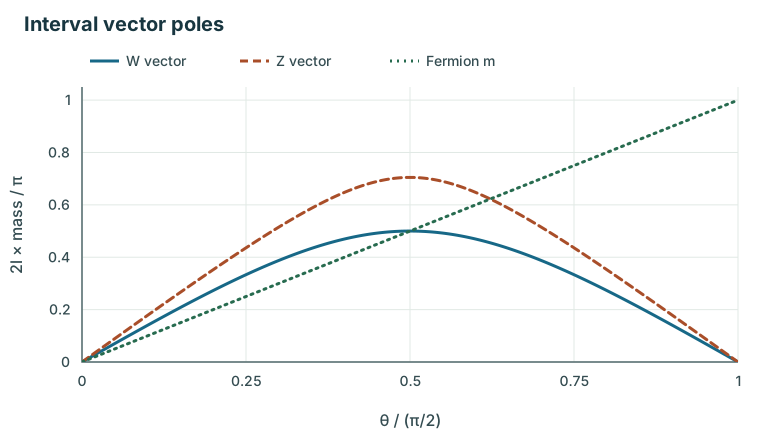
In the flat interval Yang-Mills model with the specified wall connector and kinetic form, the light vector poles obey
(2)
The small-angle limits are and . The same model also has massless vectors as at fixed . These are properties of the prescribed flat family, rather than a determination of the observed electroweak vacuum. The paper gives the exact vector result and its hypotheses, together with directions beyond the flat comparison.
Interval vector poles
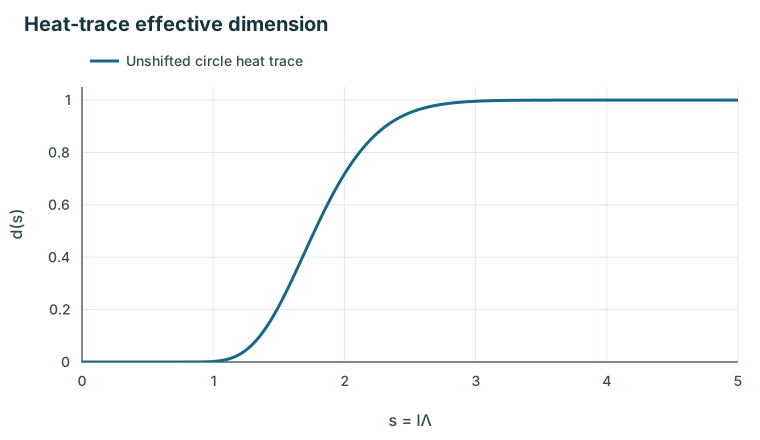
For a heat cutoff, a constant-profile vector in the transported frame and small finite masses, the leading spectral-action sum rule is
(3)
Here tends to zero for a towerless cutoff and to one in the opposite heat-trace limit. For a top-only sum, the corresponding leading ratio runs from to . The calculation assumes the stated profile and matching scale, with no running; comparison with measurements needs an effective theory and thresholds. See the effective-dimension theorem and the main paper’s spectral-action analysis.
Heat-trace effective dimension
Generations and the real structure
With three generations and Dirac neutrinos, the finite Hilbert space has 96 states and two different decompositions as : one removes the top block and the other the neutrino block. Within the single-slot root assignments and symmetry classes examined in the generations note, the sought exchange is obstructed for three families; a colour-family transposition exists for four. The comparison is a numerical fit, with the colour-covariance limitation stated in the paper. These results leave room for other embeddings, nonlinear maps, brane states and zero modes spread over several roots. They do not determine the number of generations. See the colour analysis, root configurations and the open directions.
For the five light quarks in three colours and their conjugates, the real-structure note places as the commutant of the real structure on a massless block when the relevant odd factorization has sign . The antisymmetric block of the parent interval connection and its symmetric compression to the finite window carry different representation counts. The proposed composite interpretation requires additional physical assumptions, and the note lists the unresolved wall, mass and exotic-state questions. See the sign and massless block, the interval parent, and the compression.
Completions, sources and status
The dictionary gathers the correspondence between finite data and interval or Kaluza-Klein data, with a status for each entry. Its string-duality comparison identifies specific limitations of the proposed 15+1 configuration, including its angle-position map, T-dual length and Romans mass; it points toward other chambers and completions. These statements concern that dictionary and do not settle the broader completion question.
The full Supplemental Material and its
mobile edition collect the lemmas
(01 to 52, including the eleven-dimensional line, lemmas 31 to 40, and
the additions of 4 and 5 November 2026, lemmas 41 to 52), the results
(one file per theorem), the history of the field and the literature
record; the referee reports stay in the repository under
historical/reviews, and every file here is built from
lemmas/, results/ and paper/
alone. Each paper’s page also links to its own supplement and both PDF
layouts. The research
repository contains the LaTeX sources and the ledger of claims,
dependencies and checks. Text marked “to check” in a paper retains that
status in this edition.